What Does CTL Mean for Steel Plate?
Nov 11, 2026

CTL (cut-to-length) is a shop-floor colloquialism. Steel leaves the mill in coil form: after the hot strip passes through laminar-flow cooling, a downcoiler winds it into a coil for easy lifting and long-distance transport. Yet most of the operations at the end user's plant need flat sheet. A CTL line therefore uncoils the coil, levels it flat and cuts it to the required length. The product obtained this way is known in the trade as - CTL plate.
I. The Formal Term in the Standards
The current standard GB/T 709-2019, "Dimensions, shape, weight and tolerances for hot-rolled steel plates, sheets and strips", applies to steel plate and strip of rolled width not less than 600 mm and classifies products by production method into two categories: single-rolled and continuously rolled plate, i.e. cut from coil.
What the trade calls "as-rolled flat plate" is the single-rolled plate dispatched by the mill directly in standard sizes, piece by piece; plate that is first rolled into coil and later uncoiled and sheared into pieces corresponds to what is commonly called cut to length plate. The difference between the two lies not in the steel grade, but in the delivery form and the process route: one is flat as it comes off the mill, the other only becomes flat through shearing.

II. How the Plate Is Actually Flattened
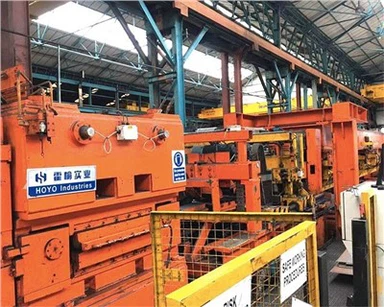
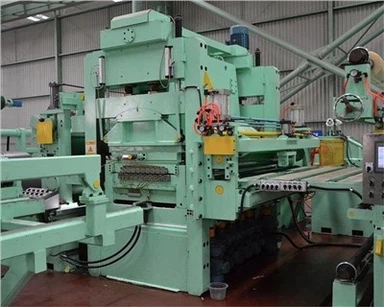
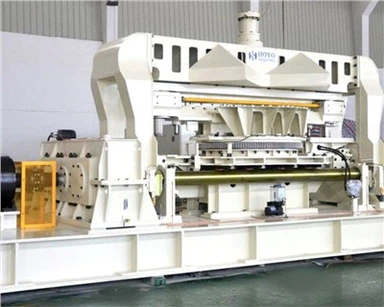
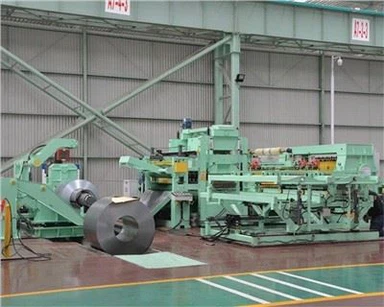
The process is not complicated: a coil car loads the coil onto the uncoiler, which expands to grip the inner diameter; the strip is threaded and guided (centered) into a multi-roll leveller, where it is repeatedly bent between staggered upper and lower work rolls, so that the internal stresses locked in by coiling are broken up and redistributed. Servo feeding, with length measured by an encoder, then drives a shear or flying shear to cut the strip to length; finished sheets travel along a conveyor to an elevator/stacking table for stacking and bundling.
It is this step that determines the final condition of the product - and it is the root of the difference between cut to length plate and as-rolled flat plate.
III. Why Cut to Length ?
Lower price, and the length can be freely specified;
Easier transport - no need to work around standard mill plate dimensions;
Convenient blanking - plate can be cut to the size actually needed;
Effective material savings. For example, a tank requires 20 pieces of 6800 × 1500 × 6 plate. Market plate is generally supplied in 6000, 8000 and 9000 mm lengths, so buying standard plate generates offcut waste. With CTL plate you simply order 6900 mm lengths and eliminate the waste - this is its greatest advantage. For stainless steel in particular, the saving in material and cost is very significant.
IV. The Cost Must Be Counted Clearly

The drawback stems precisely from that "opening it up afterwards" step. CTL plate has a higher level of internal (residual) stress than as-rolled flat plate and poorer dimensional stability; moreover, its load-carrying capacity varies with direction depending on the uncoiling and levelling parameters. The most visible consequence is severe welding distortion that is difficult to rectify. Cut to length plate is therefore unsuitable for parts with high appearance requirements and is rarely used in pressure-containing service - it is used mostly for non-pressure vessels, storage tanks and cladding/skirting panels. Critical structural members should still be made from single-rolled plate.
In the end, CTL is simply the operation that turns a coil into flat plate: cheap, flexible and material-saving, at the price of higher residual stress and only moderate dimensional stability. Whether to use Cut to length plate depends on what comes next - if it is to be welded, if appearance matters, if it must contain pressure, choose as-rolled flat plate; for straightforward blanking and assembly, tank shells and cladding panels, Cut to length plate is good enough.
If you are looking for reliable cut-to-length lines to produce high-quality CTL plates, we are a professional manufacturer and supplier of CTL cut-to-length lines. Our machines are engineered for stable operation, precise cutting and consistent levelling performance to meet your steel processing demands. Feel free to contact us for detailed specifications, quotations and technical support.