Slitting Lines
The slitting line, comprising three core capabilities-high-precision feeding, intelligent control, and efficient cutting-has become indispensable in metal sheet processing. Its value lies not only in improving production efficiency and material utilization but also in providing standardized output for downstream processes such as stamping, welding, and assembly. With Industry 4.0 advancements, future slitting lines will integrate AI visual inspection and digital twin optimization, driving the metal processing industry toward intelligent and flexible manufacturing.


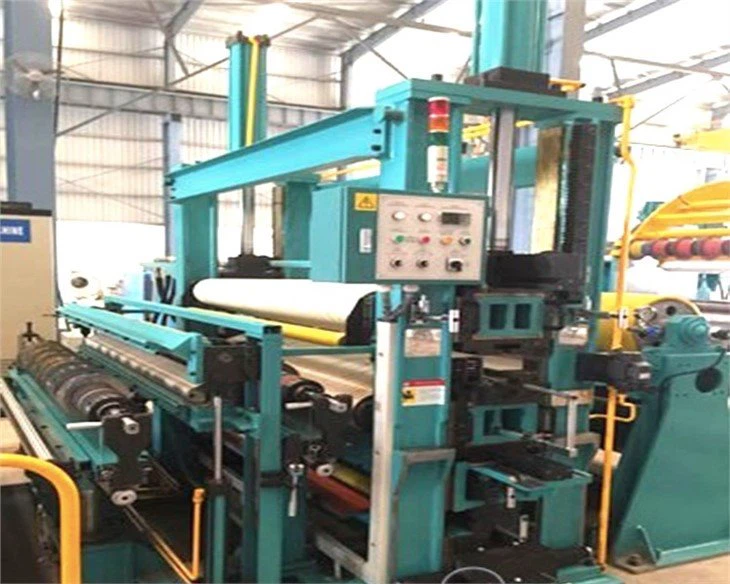

Product advantages
Strict tolerance control: Utilizing precision disc cutters and CNC technology, the slitting width tolerance reaches ±0.05mm, meeting the high-precision material dimension requirements of automotive, electronics, and other industries.
Excellent edge quality: The shearing process produces smooth, burr-free strip edges, reducing material losses in subsequent processing.
High-speed operation: Slitting speeds reach 30–300 m/min (adapting to material thickness), significantly boosting production efficiency and capacity.
Continuous operation: Fully automated processing from uncoiling to recoiling ensures uninterrupted production, ideal for high-volume order demands.
Intelligent control: Equipped with PLC or CNC systems, the line enables automatic tool adjustment, tension control, deviation correction, and online detection-significantly reducing manual intervention.
One-touch specification change: Fully automated systems support rapid production specification switching, minimizing downtime.
Edge scrap recovery: Trimming scrap is recovered via edge trim winders, minimizing raw material waste.
Flexible slitting: Slitting plans are optimized based on demand to maximize coil width utilization.
Material diversity: can process metals such as steel, aluminum, copper, stainless steel, etc., with a thickness range of 0.05-6mm and a width coverage of 300-2500mm.
Process compatibility: supports the slitting of special coils such as coatings and laminations without affecting material properties.
Tension balance: Closed-loop tension control system ensures that the material does not deflect or stretch during the slitting process.
Fault warning: Equipped with sensors to monitor the equipment status in real time to avoid unexpected shutdown or material damage.
Low energy consumption design: high-efficiency motors and energy-saving transmission systems are used to reduce operating costs.
Reduce waste: high-precision slitting and edge material recycling reduce metal dust and waste emissions.
Multi-specification production: a single slitting can produce strips of different widths to meet customized needs.
Quick return on investment: equipment costs can be quickly recovered by improving efficiency, reducing waste and labor costs.
Common types
Classification by degree of automation
- Manual slitting line
Features:
Relying on manual operation, core functions such as tool spacing adjustment, tension control, and deviation correction need to be completed manually, with simple structure and low investment cost.
Application scenarios:
Orders with small batches and multiple specifications, or processing scenarios with low precision requirements (such as slitting of ordinary steel plates for construction).
Advantages:
Low price, simple maintenance, suitable for start-ups or low-budget needs.
Disadvantages:
Low efficiency (speed is usually less than 50 meters/minute), poor slitting accuracy (tolerance is more than ±0.5mm), and reliance on skilled workers.
- Semi-automatic slitting line
Features:
Partial automation, such as automatic deviation correction and PLC-controlled tension system, but manual intervention is still required for tool change and parameter setting.
Application scenarios:
Medium-scale production, scenarios that take into account both cost and efficiency (such as slitting of metal housing materials for home appliances).
Advantages:
High cost-effectiveness, strong adaptability, slitting accuracy of up to ±0.2mm, and speed increased to 80-120 meters/minute.
Disadvantages:
Long downtime when changing specifications, and limited automation functions.
- Fully automatic slitting line
Features:
Integrated intelligent control system (such as CNC numerical control), automatic tool change, online detection, remote monitoring and other functions, supporting one-click switching of production parameters.
Application scenarios:
Large-scale continuous production, high-precision demand industries (such as new energy battery tab copper foil slitting).
Advantages:
High slitting accuracy (±0.05mm), fast speed (more than 200 meters/minute), reduced dependence on manual labor, suitable for 24-hour unmanned production.
Disadvantages:
Large equipment investment, complex maintenance, and high technical requirements for operators.
Classification by structural design
- Single-head slitting line (single station)
Features:
Equipped with only one set of unwinder and rewinder. After slitting, all narrow strips are reeled to the same station and the machine needs to be stopped for reel change.
Application scenarios:
Processing of narrow width materials or a small number of slitting strips (such as slitting of aluminum profile substrates for doors and windows).
Advantages:
Compact structure, small footprint, and low cost.
Disadvantages:
Low efficiency, frequent reel changes affect production capacity.
- Double-head slitting line (double station)
Features:
Equipped with double unwinders and double winders, continuous production can be achieved: when one set of coils is being processed, the other set is pre-installed and on standby, seamless switching.
Application scenarios:
Large batch orders (such as continuous slitting of automotive steel plates) to reduce downtime.
Advantages:
Production efficiency is increased by more than 30%, suitable for high-speed continuous operation.
Disadvantages:
Complicated equipment, high initial investment and energy consumption.
Classification by processing material thickness
- Thin plate slitting line
Features:
Designed for thin metal coils with a thickness of 0.05-2.0mm (such as copper foil, aluminum foil, galvanized sheet, etc.), the cutter uses a lightweight high-precision disc cutter.
Application scenarios:
Slitting of ultra-thin strips such as electronic components (such as flexible circuit board substrates) and food packaging can materials.
Advantages:
Slitting without burrs, avoiding scratches on the material surface, and supporting micron-level precision control.
Disadvantages:
Extremely high requirements for tension stability and complex equipment debugging.
- Medium and thick plate slitting line
Features:
Applicable to medium and thick plates with a thickness of 2.0-6.0 mm (such as stainless steel plates and marine steel plates). The cutter needs to be made of high hardness and wear-resistant material (such as tungsten steel).
Application scenarios:
Slitting of plates for engineering machinery structural parts and shipbuilding.
Advantages:
Strong shear force, can handle high-strength materials, and has high slitting efficiency.
Disadvantages:
High energy consumption and large equipment size.
Classification by functional expansion
- Universal slitting line
Features:
Standard configuration, only completes basic functions such as slitting and winding, without additional process modules.
Application scenarios:
Conventional metal strip processing (such as ordinary steel coil slitting).
Advantages:
Wide application range, low maintenance cost.
Disadvantages:
Unable to meet special process requirements (such as surface treatment).
- Multifunctional composite slitting line
Features:
Integrated modules such as coating, laminating, punching, and online detection to achieve integration of slitting and post-processing.
Application scenarios:
Customized production of high value-added products (such as laminated aluminum plates and perforated heat sinks).
Advantages:
Reduce process flow, improve yield, and be suitable for high-precision composite processing.
Disadvantages:
Expensive equipment and high technical threshold.
Special type slitting line
- High-speed precision slitting line
Features:
Designed for ultra-thin or high-precision materials (such as lithium battery copper foil), it adopts advanced technologies such as air bearing support and laser ranging, and the speed can reach more than 300 meters/minute.
Application scenarios:
New energy, precision electronics industry.
Advantages:
Ultimate accuracy (±0.02mm) and efficiency, reducing material loss.
Disadvantages:
Requires a constant temperature and humidity environment, and the operation and maintenance cost is extremely high.
- Heavy-duty slitting line
Features:
Designed for ultra-thick (6-20mm) or ultra-wide (more than 2500mm) plates, equipped with a hydraulic servo system and a high-power motor.
Application scenarios:
Slitting of extra-thick steel plates for nuclear power equipment and heavy machinery.
Advantages:
Strong shearing capacity and high stability.
Disadvantages:
The equipment is huge, and energy consumption and noise problems are prominent.
Material
Material characteristics:Carbon steel (such as SPCC, Q235) has moderate hardness and good ductility; alloy steel (such as galvanized sheet and silicon steel sheet other than stainless steel) has higher strength and corrosion resistance.
Material characteristics:Mainly grades such as 304, 316, and 430, with high hardness and strong corrosion resistance, but obvious tendency to work hardening.
Material characteristics:Pure aluminum (1 series) has excellent ductility but low strength; aluminum alloys (3 series, 5 series, 6 series) increase hardness by adding elements while maintaining lightness
Material characteristics:Pure copper (T2) has excellent conductivity; brass (H62) and bronze (QSn6.5-0.1) have high hardness and are wear-resistant and corrosion-resistant.
(1) Nickel and nickel alloys
Features and applications:
High temperature and corrosion resistance, used for battery electrodes (such as nickel-hydrogen batteries) and high-temperature aerospace components. Material brittle cracking must be prevented during slitting.
(2) Titanium and titanium alloys
Features and applications:
High strength and low density, used for medical implants and chemical reactors. Low shear speed is required during processing to reduce tool wear.
(3) Zinc and zinc alloys
Features and applications:
Good corrosion resistance, uUsed for galvanized steel strip substrates and battery zinc plates. Temperature control during slitting prevents zinc layer oxidation.
Application

Automobile Manufacturing
The slitting line cuts wide steel plates (such as galvanized plates and aluminum alloy plates) into strips of different widths for stamping parts such as doors, roofs, and chassis. The slitting accuracy (±0.1mm) ensures the matching degree of stamping dies and reduces the scrap rate.
Home appliance industry
After stainless steel or color-coated plates are cut into strips, they are used for bending and forming refrigerator and washing machine panels. The burr-free edge reduces the subsequent grinding process.
Construction and decoration
Slitting aluminum-plastic composite panels and aluminum-zinc-coated steel panels (width 100-600mm) for laying exterior walls and roofs of buildings. The cutting efficiency directly affects the progress of the project.
Electronics and Electrical
Slitting copper clad laminates (such as FR-4) to specified widths for PCB production, with an accuracy of ±0.05mm to avoid line deviation.
Packaging industry
Metal containers:
Slitting tinplate and aluminum plates (thickness 0.15-0.3mm) as the base material of cans and food cans requires smooth and burr-free cutting edges to prevent cracking during can molding.
Bottle cap and sealing materials:
Aluminum foil is used for pharmaceutical packaging and beverage bottle cap lining after slitting, and the material cleanliness and antibacterial properties must be maintained.
New energy field
Slitting aluminum alloy frames (for solar panel frames) and tinned copper strips (for battery string welding) requires efficient and continuous production to meet the needs of large-scale installation.
Aerospace and military industry
Slitting titanium alloy and aluminum alloy plates (thickness 0.5-3mm) for aircraft skins and missile shells requires extremely high stability and precision of the slitting equipment
Hardware and daily necessities
Locks and bathroom accessories:
Slit brass strips and stainless steel strips are used for stamping small hardware such as door locks and faucet valve cores.
Kitchenware manufacturing:
After slitting 304 stainless steel plates, they are stamped into blanks for pots and knives.
Components
Function: Load and unwind metal coils, fix the coil core by hydraulic or mechanical expansion and contraction of the coil, and equip with a press roller to prevent the material from unwinding. Some models support double-station switching to achieve continuous feeding.
Function: Use multiple sets of staggered straightening rollers to correct the bending of the coil, eliminate the internal stress of the material, ensure the surface is flat before slitting, and reduce subsequent shearing errors.
Function: Pull the material into the slitting main machine at a uniform speed, usually driven by a servo motor, with pinch rollers or belt mechanisms to maintain a stable feeding speed and initial tension.
Core components:
Disc cutter set: Multiple pairs of carbide or high-speed steel disc cutters are installed on the upper and lower cutter shafts, and different width slitting is achieved by adjusting the cutter spacing.
Cutter shaft drive system: Driven by a gear box or an independent motor to ensure synchronous rotation of the cutter.
Cutter adjustment mechanism: Manual/automatic adjustment of the cutter position, with an accuracy of up to ±0.05mm.
Function: Independent motor drive, recycles the edge waste (edge wire) generated by slitting, improves material utilization, and avoids waste entanglement affecting the main production line.
Composition:
Tension detection roller: real-time monitoring of material tension changes.
Closed-loop control module: PLC is used to adjust the torque or speed of the unwinder and winder to maintain constant tension during slitting and prevent material deformation or breakage.
Function: Use photoelectric or ultrasonic sensors to detect the edge position of the material, and adjust the guide roller position horizontally through hydraulic/electric actuators to ensure that the material runs along the center line and avoid slitting deviation.
Function: Rewind the slit narrow strip into independent coils. The core includes:
Rewinding shaft: Hydraulic tension or mechanical locking structure to fix the coil core.
Pressing arm: Control the material fit at the initial stage of winding.
Tension taper control: Automatically reduce the tension as the coil diameter increases to prevent the inner layer material from being deformed by pressure.
FAQ
Q: What materials can be processed by the slitting line? What is the thickness and width range?
A: The slitting line is suitable for metal coils such as steel, stainless steel, aluminum, copper, zinc, etc. Typical processing range: Thickness: 0.03mm (ultra-thin copper foil) to 20mm (extra-thick steel plate); Width: 100mm to 2500mm (some heavy equipment can reach 4000mm). Specific needs to be confirmed according to the equipment model. Special materials (such as titanium alloy) require customized tool and tension configuration.
Q: What is the slitting accuracy? How to ensure consistency?
A: Accuracy standard: ±0.1mm for ordinary models, ±0.02mm for high-precision models (such as new energy pole piece slitting). Safeguard measures: Closed-loop tension control system; Real-time deviation correction (EPC) device; Automatic tool locking and gap compensation technology; Regularly calibrate the sensor and guide roller level.
Q: How long does it take to change to different specifications? How to reduce downtime?
A: Traditional machine: Manual tool change takes 30-60 minutes; Intelligent machine: Fully automatic tool adjustment system can shorten the tool change time to less than 5 minutes. Optimization suggestions: Use pre-installed tool module; Equipped with double-station unwinding/winding machine; Adopt digital parameter memory function, one-click call historical settings.
Q: What work needs to be done for daily maintenance of the equipment?
A: Basic maintenance includes: Daily: Clean the cutter and guide roller; Check the oil level of the lubrication system; Clean the waste collection device. Weekly: Check the tightness of the transmission chain; Test the emergency stop button and safety grating function. Monthly: Calibrate the tension sensor; Check the sealing of the hydraulic system; Lubricate the bearings and gears. Annually: Replace the hydraulic oil and filter element completely; Test the insulation performance of the motor.
Q: What may be the cause of burrs or uneven edges during slitting?
A: Common causes and solutions: Tool passivation: Replace or sharpen the tool, check coating wear; Improper tool clearance: Adjust the clearance to 10%-15% of the material thickness; Uneven tension: Check the tension roller pressure and recalibrate the closed-loop control system; Material surface defects: Check whether the raw material is oxidized or scratched before slitting.
Q: 6.How to choose a slitting line that suits your company's needs?
A: The following factors need to be considered comprehensively: Material properties: thickness, hardness, surface treatment requirements; Productivity requirements: speed (m/min), continuous operation time; Precision requirements: tolerance range, edge quality; Budget and scalability: manual type (low cost) vs. fully automatic type (high investment and high return); Special functions: whether composite process modules such as lamination and punching are required. Suggestion: Give priority to modular design models to facilitate future upgrades.