Function Of Metal Plate Leveler
Oct 03, 2020
With the development of metal sheet metal frame manufacturing, the quality of sheet metal needs to adapt to the contradiction caused by the current shortage of steel and the increase in the use of high-strength steel. Due to the shortage of steel, sheet metal processing enterprises often cannot obtain the material quality they require, so they need to level the materials to further improve the quality of materials. For high-strength plates (mainly for the needs of the automobile industry), higher leveling pressure and updated leveling concept are required to obtain good flatness.
Leveler can improve the quality of metal sheet
Material stress removal by leveling technology
In order to remove the stress in the material, the plate shall be leveled. The basic principle of roller leveling is to selectively extend all parts of the material. Below the yield point of the material, the shorter part of the "fiber" of the sheet is lengthened proportionally to obtain a consistent "fiber" length. Its realization is to make the material bend up and down repeatedly with small curvature radius when passing through the leveling machine tool, so that the shorter material "fiber" can be elongated. When the sheet moves towards the exit of the leveling machine tool, the extent of up and down bending is gradually reduced to eliminate the material deformation caused by severe bending at the leveling entrance of the machine tool (Figure 1). When all the "fibers" on the material are almost the same length, the plate is straight, or "levelled".
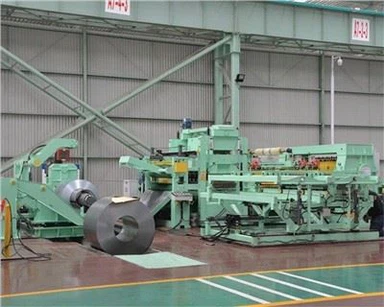
In order to obtain satisfactory leveling effect, the most important thing is to select the appropriate leveling machine according to the processing task to be completed. In most cases, the plates to be levelled start from the coil processing, and the leveler is an important part of the entire material processing production line. The simplest machine tool is the Flattener, which has a small number of leveling rolls, a large diameter and no supporting rolls. However, to obtain high flatness, small diameter leveling rolls, small roll spacing and support rolls are essential for good support of leveling rolls. Therefore, a simple skin pass mill can not produce enough deformation on the materials required to achieve good flatness, so it is not widely used.
Leveler for high strength materials
Due to the increasing use of high tensile strength materials in the manufacture of metal sheet metal frames, the leveling of materials requires greater leveling pressure. In the process of leveling, the higher leveling pressure must have an impact on the machine tool structure and the leveling roll. Solid machine tool structure and good leveling roll support are essential, which is very important to improve the leveling quality and the service life of the machine tool. If the pressure acting on the leveler is very large, effective overload protection must be designed to protect the machine tool. When leveling high strength materials, high leveling pressure is required to deform the plates, which can be achieved by reducing the spacing between leveling rolls. This is why the new leveller is equipped with a worktable adjustment mechanism. Because of the machine tool design, this is the only way to minimize the leveling roll spacing.